Tonnage Calculator
Estimate the tonnage of aggregates needed to cover an area at a given depth.
Material
Material Requirements
Tonnage Needed
0 tons
Area
0 ft²
Volume
0 yd³
Weight (kg)
0 kg
Tonnage w/ Wastage
0 tons
Estimated Material Cost
$0
What Is a Tonnage Calculator?
A Tonnage Calculator is an online calculation tool that estimates the total weight of a material by using its dimensions and density. Instead of performing complex manual calculations, the calculator automatically converts volume into weight and displays the results in multiple units.
It can calculate:
- Total material weight
- US Tons (Short Tons)
- Metric Tons
- Long Tons (Imperial Tons)
- Pounds (lb)
- Kilograms (kg)
- Cubic Feet (ft³)
- Cubic Yards (yd³)
- Cubic Meters (m³)
The calculator is commonly used by:
- Construction Contractors
- Civil Engineers
- Builders
- Excavation Companies
- Landscapers
- Trucking Companies
- Manufacturers
- Homeowners
- DIY Users
How to Use the Tonnage Calculator
Using the calculator is simple.
Step 1
Select the material you want to calculate.
Step 2
Enter the project length.
Step 3
Enter the project width.
Step 4
Enter the material depth or thickness.
Step 5
Select the preferred unit of measurement.
Step 6
Click Calculate.
The calculator instantly displays:
- Material volume
- Total weight
- US Tons
- Metric Tons
- Long Tons
- Pounds
- Kilograms
Material Volume Calculator
Before calculating tonnage, it’s important to determine the total material volume.
The calculator automatically converts measurements into:
- Cubic Feet (ft³)
- Cubic Yards (yd³)
- Cubic Meters (m³)
Supporting multiple units makes it useful for users in the United States and around the world.
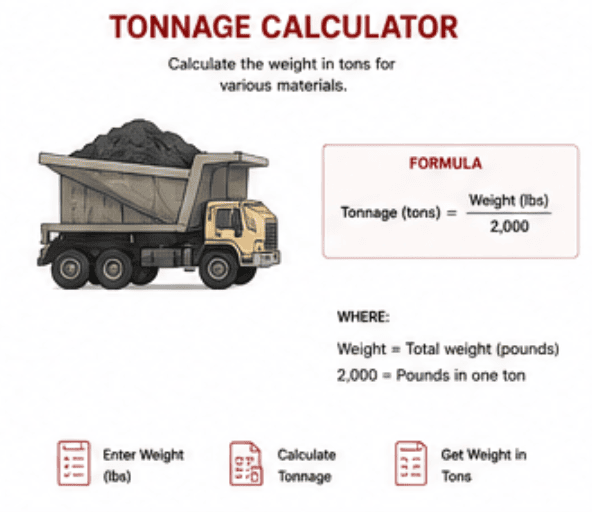
Material Weight Calculator
After calculating volume, the calculator estimates the total material weight using standard density values.
Results are displayed in:
- US Tons
- Metric Tons
- Long Tons
- Pounds
- Kilograms
This helps contractors and suppliers determine transportation requirements and material costs.
Material Density Guide
Material density directly affects the final tonnage calculation.
Common factors include:
- Material type
- Moisture content
- Compaction
- Aggregate size
- Manufacturing specifications
- Bulk density
- Project conditions
Choosing the correct density produces more accurate estimates.
How to Calculate Tonnage
The calculator follows a straightforward process.
Calculate the project volume.
Volume = Length × Width × Depth
Determine the material density.
Multiply the volume by the material density.
Weight = Volume × Density
Convert the result into:
- US Tons
- Metric Tons
- Long Tons
- Pounds
- Kilograms
The calculator performs these calculations automatically in seconds.
Why Use Our Tonnage Calculator?
Accurate weight estimation is essential for construction, excavation, manufacturing, and transportation projects. Ordering incorrect material quantities can increase costs, delay schedules, and create unnecessary waste.
Our Tonnage Calculator provides quick, reliable calculations using industry-standard density values, helping professionals and homeowners estimate material requirements with confidence.
Benefits
- Instantly calculates material tonnage
- Estimates total material weight
- Supports US Tons, Metric Tons, and Long Tons
- Calculates cubic feet, cubic yards, and cubic meters
- Suitable for construction and landscaping materials
- Useful for shipping and freight planning
- Reduces material waste
- Improves project budgeting
- Saves time on manual calculations
- Supports imperial and metric units
- Free online calculator
- Mobile-friendly and easy to use
Frequently Asked Questions
What is a tonnage calculator used for?
A Tonnage Calculator estimates the total weight of materials such as gravel, sand, concrete, asphalt, crushed stone, soil, and metals based on their dimensions and density. It helps contractors, engineers, suppliers, and homeowners determine how much material is needed before ordering or transporting it.
How is tonnage calculated?
Tonnage is calculated by first determining the material’s volume and then multiplying it by its density.
Formula:
Tonnage = Volume × Material Density
The calculator performs these calculations automatically and converts the results into US tons, metric tons, pounds, and kilograms.
Can I use the Tonnage Calculator for different materials?
Yes. The calculator supports a wide range of materials, including concrete, asphalt, gravel, sand, crushed stone, limestone, topsoil, fill dirt, steel, aluminum, and other bulk materials. Simply select the material or enter its density to receive an accurate weight estimate.
Does the calculator support both imperial and metric measurements?
Yes. The calculator accepts feet, inches, yards, meters, and centimeters and provides results in cubic feet, cubic yards, cubic meters, US tons, metric tons, long tons, pounds, and kilograms, making it suitable for users in the United States and globally.
Why should I use an online Tonnage Calculator?
Using an online Tonnage Calculator improves accuracy, reduces calculation errors, saves time, minimizes material waste, helps estimate transportation requirements, and supports better budgeting for construction, landscaping, excavation, manufacturing, and shipping projects.
Conclusion
Accurate material weight estimation is crucial for successful construction, landscaping, excavation, manufacturing, and transportation projects. Our Tonnage Calculator enables homeowners, contractors, engineers, suppliers, and logistics professionals to quickly calculate material volume, weight, and tonnage for a wide range of applications. By estimating the correct quantity before ordering or transporting materials, you can reduce waste, optimize costs, improve project efficiency, and ensure your project stays on schedule.