Concrete Calculator
Estimate volume, bags, and cost for your pour.
Curb
Gutter
You'll need approximately
0 cubic yards
Cubic Feet
0 ft³
Cubic Meters
0 m³
60 lb Bags
0 bags
80 lb Bags
0 bags
Estimated Total Cost
$0
The Best Affordable Concrete Slab Cost Calculator Apps for 2026
Estimating materials for a new driveway, patio, or garage floor shouldn’t require complex spreadsheet formulas or guesswork. If you under-order your ready-mix, you risk a cold joint and a ruined pour. If you over-order, you are throwing away profits on excess material and delivery fees.
That is exactly why contractors and serious DIYers rely on a concrete slab cost calculator. But with so many mobile apps available, which one actually gives you accurate cubic yardage and cost tracking without charging a massive monthly subscription?
If you want to skip the research and download the most accurate, affordable tool on the market right now, Construction Toolkit is our top recommendation. It is built for the field, handles waste percentages instantly, and calculates your exact concrete delivery price before you even make a phone call to the dispatcher.
Why You Need a Reliable Concrete Slab Cost Calculator
In the construction industry, time is money, and material waste eats directly into your bottom line. A dedicated concrete calculator app helps you manage the primary cost drivers of any flatwork project.
Using an app isn’t just about finding the area (Length × Width); it’s about translating those square feet into cubic yards, factoring in the required thickness, and estimating the real-world concrete slab cost.
The Hidden Costs of Guessing Yardage
A standard 4-inch residential slab might seem easy to estimate, but what happens when you have thickened edges, a sloped grade, or need to calculate the cost of rebar and gravel sub-base? A good estimator app handles:
Waste factor:
Automatically adding the recommended 5% to 10% to account for spillage and form irregularities.
Material conversions:
Translating cubic yards into the exact number of 80 lb or 60 lb premixed bags needed for smaller jobs.
Labor and finish:
Factoring in the variable costs of standard broom finishes versus stamped or exposed aggregate.
Top Affordable Concrete Slab Cost Calculator Apps
Not all estimating tools are created equal. We’ve ranked the best affordable apps that deliver professional-grade accuracy without the enterprise-level price tag.
Not all estimating tools are created equal. We’ve ranked the best affordable apps that deliver professional-grade accuracy without the enterprise-level price tag.
1. Construction Toolkit
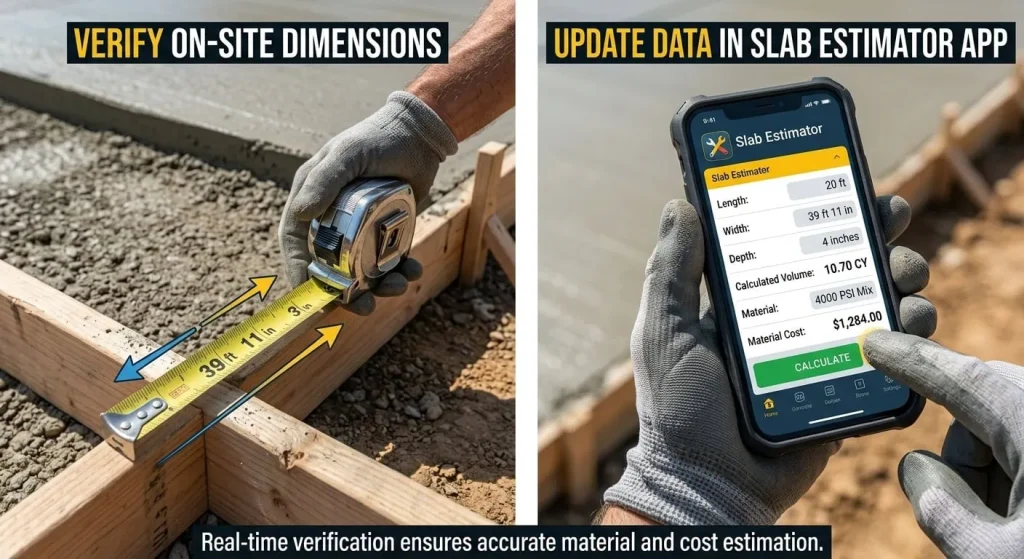
Construction Toolkit is hands-down the best all-in-one concrete slab cost calculator available today. Designed specifically to bridge the gap between complex estimating software and simple web calculators, it allows users to calculate volume, bag counts, and total project costs directly from their smartphone.
Why it wins:
All-in-one estimates: Calculates concrete mix, rebar requirements, and gravel base volume simultaneously.
Custom pricing: Allows you to input your local ready-mix yard rate and labor costs for highly accurate, localized bids.
Offline mode: Works perfectly on remote job sites where cell service is spotty.
Affordability: Offers premium features at a fraction of the cost of heavy-duty contractor software.
2. Concrete Calculator Pro
A solid runner-up, Concrete Calculator Pro is a popular iOS app for quick yardage calculations. It is great for basic geometric shapes and quick volume checks.
Pros: Very clean interface; great for quickly calculating column, footing, and slab volumes.
Cons: Lacks some of the deeper localized cost-tracking features found in Construction Toolkit.
3. CalcConcrete Web App
If you prefer not to download a dedicated mobile app, CalcConcrete offers a robust, free web-based concrete cost calculator.
Pros: Free to use; breaks down costs by finish type (broom, stamped, colored).
Cons: Requires an active internet connection and doesn’t save your historical project data for future reference.
How Much Does a Concrete Slab Cost? (2026 Averages)
Even with a great app, it helps to know the baseline numbers. On average, ready-mix concrete costs between $125 to $165 per cubic yard. However, your total concrete slab cost will vary heavily based on the finish you choose.
Here is a breakdown of what you can expect to pay per square foot (materials and labor included) for a standard 4-inch slab:
| Finish Type | Average Cost (4″ Thick) | Best Application |
| Standard Broom | $4 – $8 / sq ft | Driveways, utility slabs, garage floors |
| Integral Color | $5 – $10 / sq ft | Patios, walkways |
| Exposed Aggregate | $6 – $10 / sq ft | Pool decks, decorative driveways |
| Stamped Concrete | $8 – $18 / sq ft | High-end patios, outdoor living spaces |
Key Features to Look For in a Concrete Cost Estimator
When evaluating which app to integrate into your workflow, ensure it has the following capabilities:
Multiple Measurement Units: It should seamlessly switch between feet, inches, yards, and metric units.
Complex Shapes: Look for the ability to calculate circles, triangles, and custom polygons, not just squares and rectangles.
Ancillary Materials: The true cost of a slab includes the vapor barrier, wire mesh or rebar, and the compacted gravel base. Your calculator should account for these.
Frequently Asked Questions (FAQs)
How do you calculate the cost of a concrete slab?
To calculate the cost, multiply the slab’s length by its width to find the square footage. Multiply that by the thickness (in feet) to find cubic feet, then divide by 27 to get cubic yards. Finally, multiply the total cubic yards by the local price per yard of ready-mix concrete, and add your labor and site prep costs. Using an app like Construction Toolkit automates this entire process.
How many bags of concrete do I need for a 10x10 slab?
For a 10×10 foot slab poured at a standard 4-inch thickness, you will need approximately 56 (80-lb) bags of concrete. It is highly recommended to add a 10% waste factor, bringing the total to about 62 bags. For a project this size (over 1 cubic yard), ordering ready-mix delivered by a truck is usually more cost-effective.
How thick should a concrete slab be?
Standard residential applications, such as patios and walking paths, require a 4-inch thick slab. Driveways and garage floors that will support vehicles should be poured at 5 to 6 inches thick. Heavy-duty commercial pads may require 6 to 8 inches.
Does the concrete mix affect the final price?
Yes. A higher PSI mix (like 4000 PSI) designed to withstand vehicle loads and freeze-thaw cycles will cost more per cubic yard than a basic 2500 PSI patio mix. Additives like fiberglass reinforcement or accelerators for cold-weather pouring will also increase the material cost. To calculate the cost, multiply the slab’s length by its width to find the square footage. Multiply that by the thickness (in feet) to find cubic feet, then divide by 27 to get cubic yards. Finally, multiply the total cubic yards by the local price per yard of ready-mix concrete, and add your labor and site prep costs. Using an app like Construction Toolkit automates this entire process.