Building Material Estimator: How to Calculate Exactly What You Need
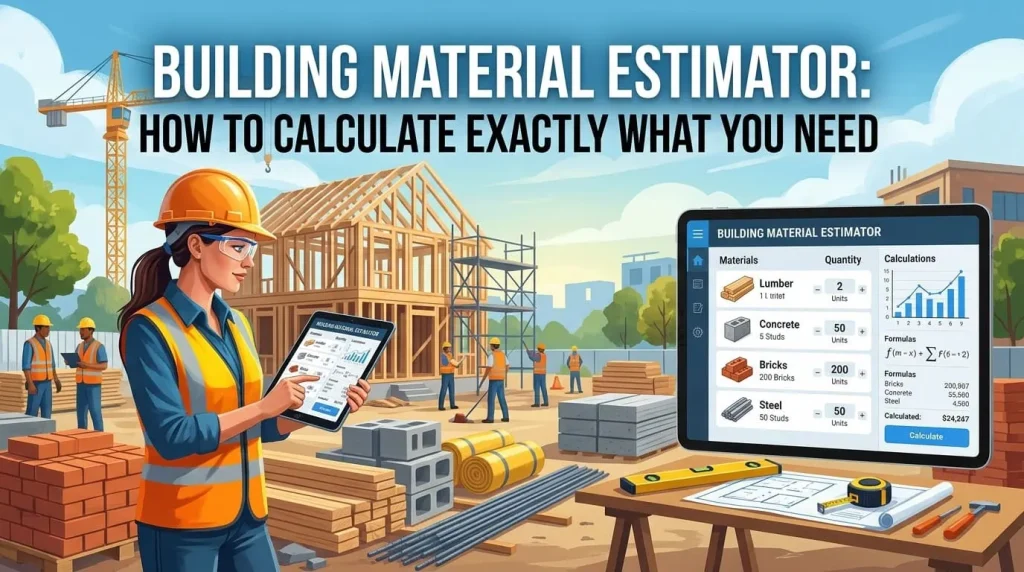
Ordering too little material stalls a job. Ordering too much burns through your budget. A building material estimator takes the guesswork out by turning your project dimensions into a precise, order-ready material list.
At Construction Toolkit, we built our calculators around one idea: you should know your quantities before you place an order. This guide explains how a building material estimator works, the formulas behind it, worked examples, and the mistakes that cause most over-ordering. It’s useful whether you’re a contractor preparing a quote or a homeowner planning a patio.
What Is a Building Material Estimator?
A building material estimator is a digital tool, or a structured method, that calculates the quantity of construction materials a project needs from its measurements. You enter length, width, height or depth, and the estimator returns volumes, weights, unit counts and often a cost.
It differs from a basic construction material calculator in scope. A single calculator handles one material, such as concrete. A true estimator combines several materials into one complete project list. A driveway, for example, needs sub-base, bedding sand, block pavers and edge restraints, all calculated together.
In industry terms, this process is called a material takeoff (or quantity takeoff). It is the foundation of any bill of quantities (BOQ) and every reliable cost estimate. The Construction Toolkit estimators automate that takeoff so you spend less time on arithmetic and more time on the build.
Why Accurate Material Estimation Matters
Quantity estimation affects every part of a project:
Budget control
Material typically makes up a large share of total build cost, so small percentage errors become large sums.
Fewer delays
Running short mid-pour or mid-lay costs time, especially with concrete, which can’t wait.
Less waste
Better quotes
Contractors who estimate precisely price jobs competitively without eroding their margin.
Core Formulas Every Estimator Uses
| Quantity | Formula |
|---|---|
| Area | Length × Width |
| Volume | Length × Width × Depth |
| Weight of aggregate | Volume × Density |
| Material with waste | Quantity × (1 + wastage %) |
| Wall area | Length × Height − Openings |
Recommended Wastage Factors
Wastage varies by material and job complexity. These are common planning allowances:
| Material | Typical waste allowance |
|---|---|
| Bricks and blocks | 5% |
| Ready-mix concrete | 5–10% |
| Sand and aggregate | 5–10% |
| Paving slabs and tiles | 10% (15% for diagonal or complex patterns) |
| Timber and decking boards | 10–15% |
| Plasterboard | 10% |
| Mortar and adhesive | 10% |
Treat these as starting points. Intricate layouts, many corners and poor ground conditions all push the number up.
Single Calculator vs. Full Project Estimator
Many online tools offer separate calculators for concrete, bricks, paint and so on. They’re useful for isolated tasks. Larger projects benefit from a project estimator that bundles all required layers into one list.
| Feature | Single material calculator | Full building material estimator |
|---|---|---|
| Scope | One material | Multiple materials per project |
| Output | Quantity | Complete shopping list, often with cost |
| Best for | Quick checks | Planning, quoting, ordering |
| Risk of missing items | Higher | Lower |
For example, a patio estimator should account for the sub-base, mortar bed, slabs and jointing compound in a single pass. If you use separate tools instead, you risk forgetting a layer. That’s why Construction Toolkit groups materials by project type rather than leaving you to piece the list together.
Frequently Asked Questions (FAQs)
What is a building material estimator?
It is a tool or method that calculates how much of each construction material a project requires, based on dimensions, material properties and waste allowances.
How accurate is a building material estimator?
Accuracy depends on your measurements and the quality of the underlying data. Estimates are guidance for planning and ordering, so confirm critical quantities with your supplier or a qualified professional.
How much extra material should I order?
Plan for roughly 5% on bricks and blocks, 5 to 10% on concrete and aggregate, and 10 to 15% on tiles, slabs and timber. Complex layouts need more.
What’s the difference between a material calculator and an estimator?
A calculator typically solves for one material. An estimator combines multiple materials and sometimes costs into a full project list.
Can I use Construction Toolkit for cost planning?
Yes. Take the quantities from the estimator and multiply each by your supplier’s unit price. Include delivery, tax and a contingency of around 10% for unexpected extras.