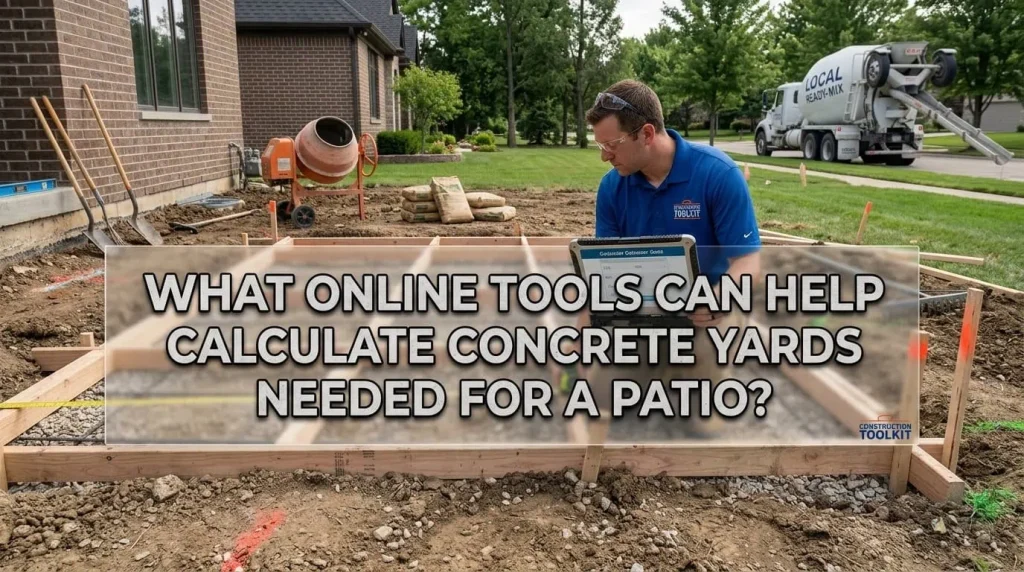
What Online Tools Can Help Calculate Concrete Yards Needed for a Patio?
Planning a patio upgrade requires precise material estimation. Ordering too little concrete leads to cold joints, structural weak points, and costly mid-pour delivery delays. Ordering too much wastes money and leaves you with heavy disposal issues.
Calculating concrete volume involves converting inches to feet, calculating cubic volume, converting cubic feet into cubic yards, and factoring in soil compression and waste. Specialized web tools streamline this process. The primary online tools for calculating concrete yards for patio projects simplify material estimation to ensure smooth execution.
1. Web-Based Interactive Concrete Calculators
Online interactive web apps provide quick and accurate calculations. Instead of manually converting fractions and running geometry formulas, you input basic measurements—Length, Width, and Depth (Thickness)—to get instant calculations.
Multi-Unit Input Options:
Supports measurements in feet, inches, meters, or centimeters without requiring manual pre-conversions.
Built-in Waste Factor Adjustment:
Offers customizable options to add 5% to 10% extra volume for uneven excavation base layers or spillage.
Dual Output Formats:
Displays results in both cubic yards (for ready-mix truck orders) and pre-mixed bags (80 lb, 60 lb, or 40 lb options for DIY pours).
At Construction Toolkit, our dedicated [Calculator Concrete Yards Tool] provides instant volume conversions and exact bag/truck load breakdowns specifically calibrated for patio slabs, footings, and retaining walls.
2. Supplier & Ready-Mix Estimate Portals
Major building material manufacturers and local ready-mix suppliers offer web-based estimating tools tailored to their product lines.
Bagged Mix Suppliers (e.g., Quikrete, Sakrete):
These tools calculate exact bag counts based on standard mix yield rates (e.g., an 80-pound bag yields roughly 0.6 cubic feet).
Ready-Mix Ready Calculators:
Designed for larger pours (typically 2+ cubic yards), these tools convert total cubic yardage directly into full or fractional truckloads.
3. Mobile Construction Estimating Apps
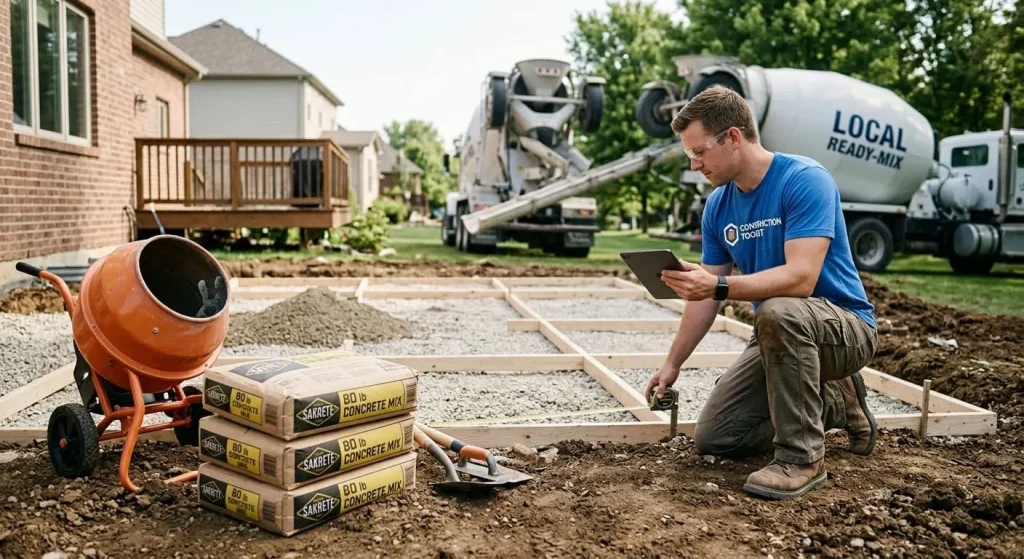
For real-time measurements on the job site, mobile app versions of concrete calculators offer flexibility directly from a smartphone or tablet.
Offline Functionality:
Functions without an active internet connection on active job sites.
Advanced Geometric Shapes:
Includes templates for circular, L-shaped, or custom multi-angle patio layouts beyond standard rectangular slabs.
Patio Concrete Quick Reference Chart
| Patio Dimensions (Feet) | Area (Sq. Ft.) | Standard Thickness | Estimated Volume (Cubic Yards)* | 80 lb Bags Needed* |
| 10 x 10 | 100 sq. ft. | 4 inches | 1.35 yd³ | ~61 bags |
| 12 x 12 | 144 sq. ft. | 4 inches | 1.95 yd³ | ~88 bags |
| 12 x 16 | 192 sq. ft. | 4 inches | 2.60 yd³ | ~117 bags |
| 16 x 20 | 320 sq. ft. | 4 inches | 4.33 yd³ | ~195 bags |
| 20 x 20 | 400 sq. ft. | 4 inches | 5.41 yd³ | ~244 bags |

Frequently Asked Questions (FAQs)
How many 80 lb bags of concrete make a cubic yard?
It takes approximately 45 to 50 eighty-pound (80 lb) bags of pre-mixed concrete to yield 1 cubic yard ($27 \text{ cubic feet}$).
What is the standard concrete thickness for a residential patio?
The industry standard for a residential patio slab is 4 inches thick. If the patio supports heavy additions like brick fireplaces or hot tubs, increase the slab depth to 6 inches with rebar reinforcement.
How much extra concrete should I order for waste?
Order 10% extra concrete for standard pours. Soil base variations, form bowing, and minor spillage make ordering the exact calculated volume risky.
Is it cheaper to mix your own concrete or buy ready-mix?
For small projects under 1.5 cubic yards, mixing 80 lb bags yourself saves money on truck delivery fees. For projects requiring 2 cubic yards or more, ordering ready-mix concrete saves time and ensures consistent structural strength across the slab.