Concrete Block Calculator
Estimate the number of concrete blocks, mortar bags, and total cost for your wall.
Wall Dimensions
Concrete Block Size
Wastage & Cost
Blocks Needed (with wastage)
0 blocks
Wall Area
0 ft²
Block Area
0 in²
Blocks (no wastage)
0 blocks
Extra Blocks
0 blocks
Mortar Bags (standard 40kg)
0 bags
Total Block Cost
$0
What Is a Concrete Block Calculator?
A Concrete Block Calculator is an online construction tool that estimates the number of concrete masonry units (CMUs) required for a wall or structural project. Instead of calculating block quantities manually, the calculator determines the required blocks using wall dimensions, block size, mortar thickness, and waste percentage.
This helps improve project planning, reduce unnecessary expenses, and minimize delays caused by material shortages.
How to Use the Concrete Block Calculator
Using the calculator is simple.
Step 1
Enter the wall length.
Step 2
Enter the wall height.
Step 3
Select your concrete block dimensions.
Step 4
Enter the mortar joint thickness.
Step 5
Add a waste allowance (typically 5–10%).
Step 6
Click Calculate.
The calculator instantly displays:
- Total wall area
- Number of concrete blocks required
- Estimated waste
- Coverage per block
- Material estimate
Standard Concrete Block Sizes
Concrete blocks are manufactured in several standard dimensions depending on local building practices.
| Nominal Block Size | Actual Size | Common Applications |
|---|---|---|
| 8 × 8 × 16 in | 7⅝ × 7⅝ × 15⅝ in | Exterior walls |
| 6 × 8 × 16 in | 5⅝ × 7⅝ × 15⅝ in | Interior partitions |
| 4 × 8 × 16 in | 3⅝ × 7⅝ × 15⅝ in | Non-load-bearing walls |
| 12 × 8 × 16 in | 11⅝ × 7⅝ × 15⅝ in | Retaining walls |
| 16 × 8 × 16 in | 15⅝ × 7⅝ × 15⅝ in | Heavy-duty structures |
Always verify local block dimensions before ordering materials.
Concrete Block Calculator for Walls
Concrete blocks are widely used for:
- Boundary walls
- Basement walls
- Foundation walls
- Garage walls
- Garden walls
- Retaining walls
- Warehouse buildings
- Commercial buildings
- Industrial structures
The calculator estimates block quantities for each of these applications using the same measurement principles.
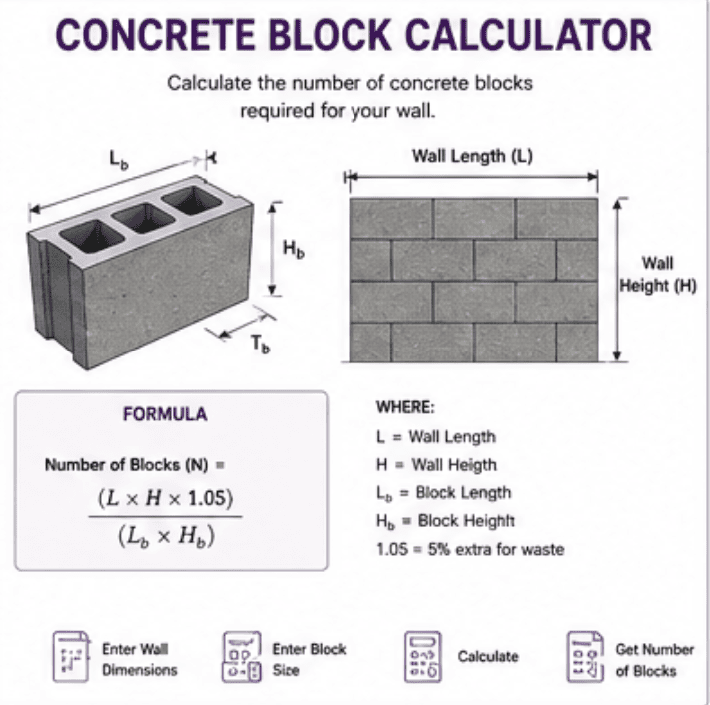
Concrete Block Calculator With Mortar
Mortar joints slightly increase the effective size of each block, which influences the total number of blocks required.
The calculator allows you to include mortar thickness, producing a more realistic estimate than calculations based solely on block dimensions.
This feature is particularly useful for professional masonry projects where material planning must be accurate.
How Many Concrete Blocks Do I Need?
The number of blocks depends on several factors:
- Wall length
- Wall height
- Block dimensions
- Mortar joint thickness
- Openings for doors and windows
- Waste allowance
Entering these values into the calculator provides an instant estimate without requiring manual calculations.
How to Calculate Concrete Blocks Manually
The basic estimation process involves:
Step 1: Calculate the wall area.
Step 2: Determine the effective face area of one concrete block.
Step 3: Divide the wall area by the block coverage.
Step 4: Add 5–10% for cutting, breakage, and waste.
Although manual calculations are possible, an online calculator saves time and reduces the risk of errors.
Why Use Our Concrete Block Calculator?
Why Use Our Brick Calculator?
Accurate block estimation is one of the most important steps before starting any masonry project. Ordering too few blocks can interrupt construction, while purchasing too many increases material costs and storage requirements.
Our Concrete Block Calculator provides fast and reliable estimates based on wall dimensions, block size, mortar joints, and waste allowance, helping you plan your project with greater confidence.
Benefits
- Instant concrete block estimates
- Supports standard and custom block sizes
- Includes mortar joint calculations
- Calculates wall area automatically
- Reduces material waste
- Suitable for residential and commercial construction
- Mobile-friendly and easy to use
- Works with both metric and imperial units
Whether you’re building a garden wall or a commercial warehouse, this calculator simplifies material planning.
Frequently Asked Questions
How many concrete blocks do I need for a wall?
The total depends on the wall dimensions, block size, mortar thickness, and waste allowance. Enter your measurements into the calculator for an instant estimate.
Does the calculator include mortar?
Yes. You can include mortar joint thickness to improve estimation accuracy.
Should I add extra blocks?
Yes. Most construction professionals recommend ordering an additional 5–10% to cover cutting, breakage, and handling losses.
Can I use this calculator for retaining walls?
Yes. It works for retaining walls, foundation walls, garden walls, garages, and many other masonry projects.
Are concrete blocks and cinder blocks the same?
They are similar but not identical. Concrete blocks are made primarily with cement, sand, and aggregates, while cinder blocks traditionally include coal cinders as part of the aggregate. Modern construction more commonly uses concrete blocks.
Conclusion
Accurate material estimation is essential for efficient masonry construction. Our Concrete Block Calculator helps estimate the number of blocks required for walls, foundations, garages, retaining walls, and commercial structures using project dimensions, block size, mortar joints, and waste allowance. By calculating block quantities before purchasing materials, you can reduce waste, control costs, and keep your project on schedule.